
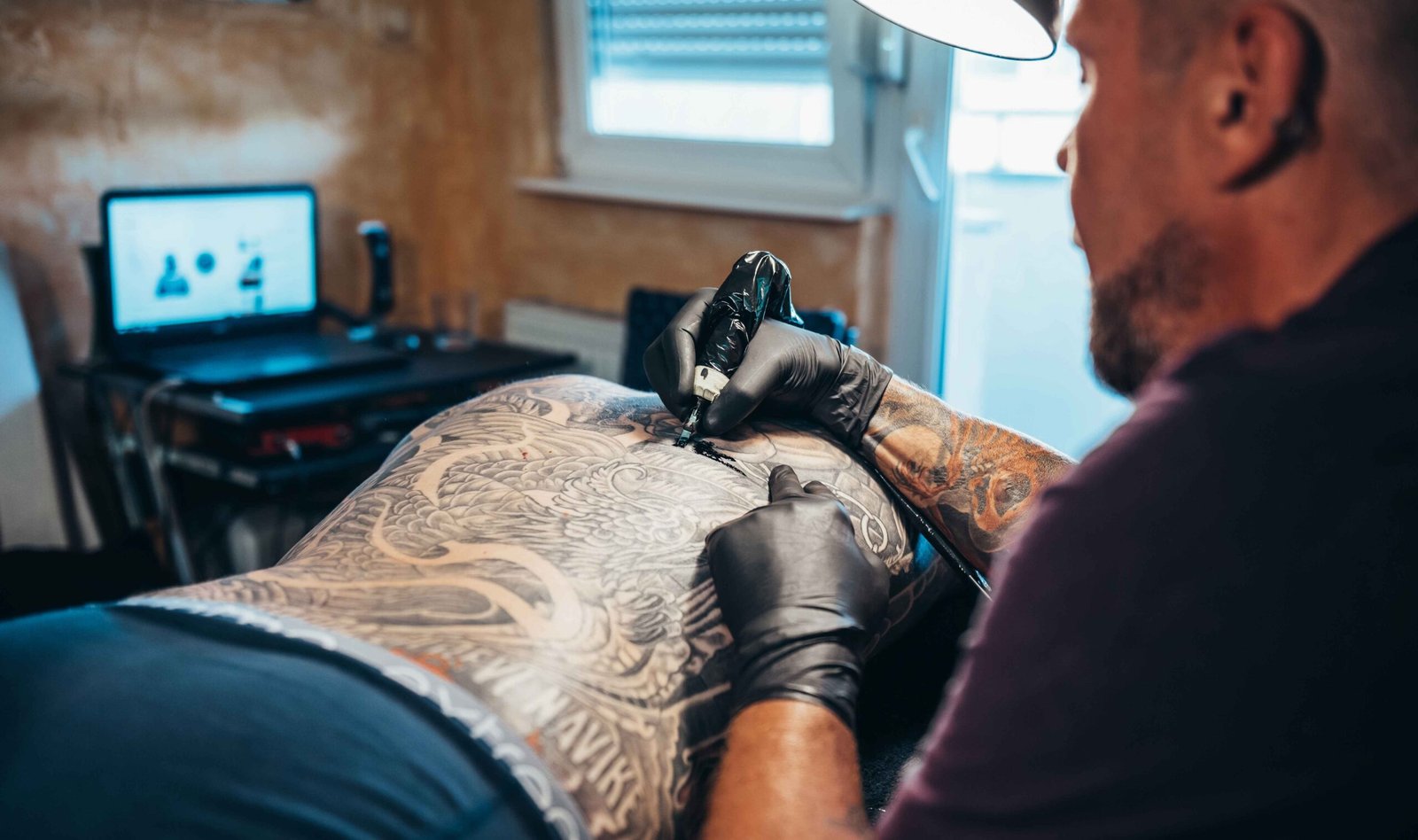
Teaching yourself to tattoo isn’t simply about finding enough information. The thing that replaces an apprenticeship isn’t a different kind of teacher. It’s becoming the kind of person who can teach themselves.
Teaching yourself to tattoo, and I mean genuinely mastering the craft without a classroom, a mentor telling you what matters or a structured curriculum holding your hand through it, is a skill.
The thing that replaces an apprenticeship isn’t a different kind of teacher. It’s becoming the kind of person who can teach themselves.
Teaching Yourself to Tattoo Starts with Learning How to Learn
Not in a showing-off way, but in a way where they can talk about almost anything with depth, connect ideas from completely different fields and see things other people miss.
I first met people like this when I was a kid working in a recording studio. I was a fairly poorly educated kid and I remember thinking, “How did they get like that?”
At first I assumed they’d been to better schools than me. Maybe they were just older. But as I made endless cups of tea and sat in on recording sessions, I noticed something.
They didn’t just know more than I did. They learned differently.
That difference wasn’t intelligence.
It was a skill.
So I’m going to walk you through how genuinely self-educated people think and learn. Not the generic “read more books” advice, but the habits that actually change the way you acquire knowledge and what you do with it.
Judgement and Perspective
For most of tattoo history, learning wasn’t really a problem.
You found an apprenticeship by getting tattooed. If you got on with the tattooist you plucked up the courage and asked them to teach you. If they thought you were made of the ‘right stuff’ you were in.
Once you were in somebody else decided what mattered, what order to learn things in and corrected mistakes before they became habits. Today the situation is completely different. Tattooing exploded in popularity. Thousands more people want to become tattooists and there’s simply not enough experienced artists willing, or able, to train them.
But nature abhors a vacuum.
And that vacuum has been filled by schools, weekend courses, “become a tattoo artist like me” programmes or simply teaching yourself at home, like you probably are. Some ways are undoubtedly better than others, but none of them solve the real problem.
Because information isn’t the scarce resource it once was.
Judgement and perspective are.
So if information isn’t the scarce resource anymore, perhaps we’ve been looking at learning tattooing all wrong.
As a largely self-taught artist who’s been in this industry long enough to teach a few people ‘the right way’ myself, I’m acutely aware that an apprenticeship never simply gave you the ‘how to’ of tattooing. It was never ‘do these five things and you’ll be a tattooist’.
It’s far, far more.
There is no substitute for the generational perspective and judgement handed down in this way.
If we take away the actual tattooing part, a traditional apprenticeship gave you access to somebody else’s judgement. And a cultural perspective that’s been handed down over the last 150 years.
A mentor was someone who could tell you what mattered and what didn’t. Someone who had already made the mistakes you hadn’t yet made and could help you avoid—or learn from—yours.
If that person isn’t available to you, and let’s be honest good apprenticeships are harder and harder to find these days, the challenge isn’t finding another source of information or another teacher. It’s developing your ability to judge information, decide what deserves your attention and assemble those pieces into understanding.
For us it’s about taking 150 years of electric tattooing and as many perspectives on it as we can find from every generation of artists, then turning that into an original thought that can be explained in simple terms.
Putting ink in skin is a practical skill.
Understanding tattooing as a craft, a culture and a profession is something else entirely.
That’s what self-education really is.
Learning in a way that you understand the subject. Rather than just reading about it.
Teaching Yourself to Tattoo Isn’t Just Consuming Information
Before we go any further, I think it’s worth clearing up the biggest misunderstanding people have about teaching themselves.
Because most people’s approach to self-education looks something like this.
They consume.
Watch.
Read.
Listen.
They watch ten tattoo tutorials. They follow fifty great tattooists. They save hundreds of reference images. But ask them why one tattoo works better than another, and they’re often left describing what they can see rather than explaining what they understand.
But if you asked them to explain what they’d actually learned, connect it to something else or apply it in a meaningful way, most of it would already be gone.
Not because they’re unintelligent.
Because consumption and education are not the same thing.
Treating them as though they are is probably the most expensive mistake people make when trying to teach themselves anything.
The other major pitfall is refusing to be wrong.
Self-educated people have to become comfortable dismantling their own beliefs.
If every new piece of information threatens your identity, you’ll stop learning long before you stop consuming.
I think that’s one of the reasons I have no problem with people challenging my ideas. I have to accept there may be a better explanation or approach than mine.
I try to develop ideas, not dogma.
Ideas can evolve. Dogma has to be defended.
Building, Not Collecting
And as I’m putting this piece together, I’m starting to realise that I’ve been doing the same thing over and over again since the very first time I realised traditional education just didn’t suit me.
I didn’t dislike learning.
I disliked the way I was being taught.
School often felt like disconnected facts and ideas that were somehow supposed to add up to something called “knowledge”. To me, it looked more like just enough information to pass an arbitrary memory test than genuine understanding.
The first time I remember discovering a different way of learning was when I started teaching guitar to my friends.
I noticed something almost immediately.
Teaching them made me better.
The moment I had to explain an idea in my own words, I discovered whether I actually understood it or whether I’d simply copied somebody else’s explanation.
Every question exposed another gap in my understanding. So I became my own teacher.
Without really thinking about it, I kept repeating the same process. I taught myself music, graphic design, marketing and writing.
Then tattooing. Then YouTube.
It turns out I’d been accidentally following the same principles for years before I ever knew there was a name for them.
That name belongs to Richard Feynman.
Feynman was a Nobel Prize-winning physicist, but what made him exceptional wasn’t raw intelligence. It was the standard he held himself to when it came to understanding something.
His rule was beautifully simple.
If you can’t explain something in your own words, as though you’re teaching somebody who knows absolutely nothing about the subject, you don’t understand it yet.
The explanation is the proof of understanding, not a summary of it.
That’s a completely different way of thinking about learning. Most people approach education as though they’re collecting information.
Feynman approached learning like building.
Every new idea had to connect to something that was already there. It had to strengthen the structure. A disconnected fact was almost useless because it couldn’t support anything else.
Once you start thinking that way, everything changes.
You stop collecting ideas
and start building understanding.
And I think that’s what separates someone who has read fifty books and retained almost nothing from someone who has read twenty books and can still discuss them with genuine depth years later.
The second person was building.
The first person was collecting.
Go to the Source
Primary sources are another essential part of genuine self-education that most people actively avoid.
For example, back in the day, some of my favourite guitar players always name checked Leslie West. So I studied Leslie West as well as Eddie Van Halen.
Eventually I realised that every great artist has influences of their own. If you want to understand why someone thinks the way they do, you have to keep following those influences backwards.
The internet has created an ecosystem of summaries, simplified explanations and five-minute breakdowns of complex ideas. They have their place.
But there’s a cost.
You receive the conclusion without the reasoning. The what without the how or the why.
Digging until you find the primary source lets you experience the purity of the thinking that produced the idea and discover the starting point from which everything else exploded.
Why Every Great Tattooist Eventually Ends Up Teaching Themselves
At its highest level, self-education is really just one habit practised consistently.
Never allowing yourself to stop at surface understanding.
Every time you encounter an idea that matters, push beyond familiarity.
Connect it.
Apply it.
Challenge it.
That standard, maintained over years of genuine curiosity, produces the kind of person who appears to know a remarkable amount.
Not because they collected more information than everyone else.
Because they built something with it.
And I think that’s the real lesson. An apprenticeship can teach you how one experienced tattooist thinks.
One mentor.
One voice.
Learning how to educate yourself teaches you how to keep finding new information, connecting the dots and improving for the rest of your career.
I think that, at some point, every great tattooist becomes self-taught. We acquire knowledge little by little during our careers and eventually, if we’re paying attention, we start to build our own opinions based on everything we’ve learnt from our apprenticeship to the conversation in the bar last night.
The question isn’t whether you’ll eventually become self-taught.
The real question is whether you’ll know how to teach yourself when you do.