
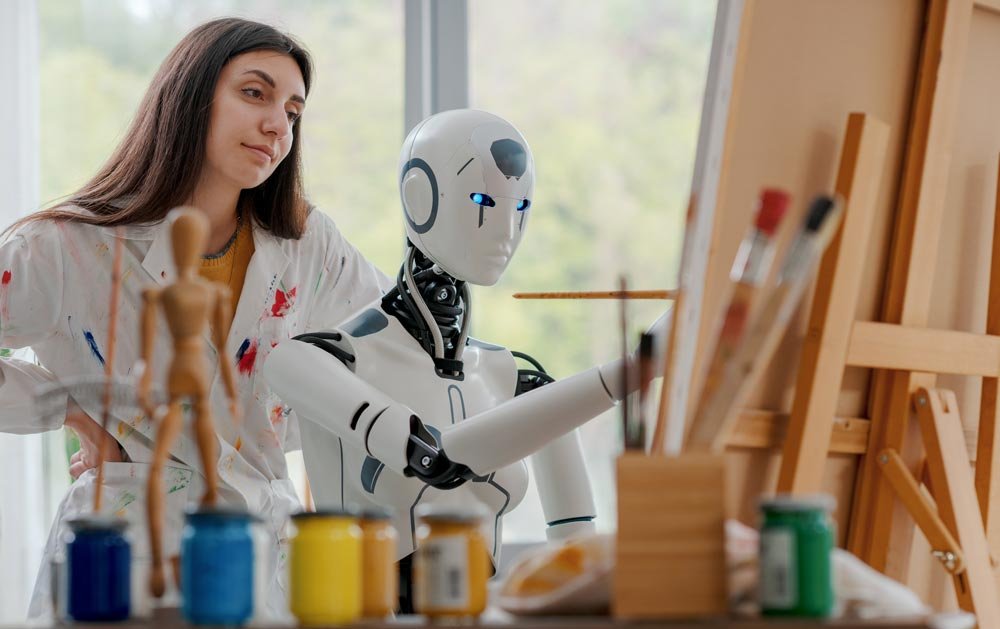
Why tattoo artists should stop asking whether AI belongs in tattooing and start asking where it belongs in the workflow.
Over the last few months I’ve started seeing something I predicted back in 2024 when I spoke at Paradise Tattoo Gathering.
I finished that talk with a prediction.
“Those who replace everything with machines will be efficient, but those who capitalise on human connection will be loved.”
At the time I wasn’t making a moral argument against AI. I was making an economic one.
I wasn’t predicting AI would fail. I was predicting that businesses would eventually discover there’s a difference between replacing labour and replacing value.
Looking at what’s happening now, I think that’s exactly what’s happened.
Two years ago everyone was convinced AI was about to replace huge swathes of creative work, customer service and entire professions. My advice back then was surprisingly simple.
Stay human. Work slowly. Make things.
Not because AI wasn’t impressive. It clearly was. But because tattooing has never really been about producing images. It’s about understanding another human being. It’s about trust. It’s about conversation. It’s about making somebody feel comfortable enough to let you permanently change their body.
That’s the product. The drawing is only part of it.
Now, barely two years later, many of the companies that rushed headfirst into AI are quietly rowing backwards. Customer service departments are being re-staffed. Human editors are being rehired. Businesses that proudly announced their AI-first strategies are discovering that, by removing people, they’ve accidentally removed the thing customers actually valued.
The backlash isn’t happening because AI suddenly became worse.
It’s happening because people finally experienced it. Not the ‘iPhones growing on trees’ version of it. Not the promise. The reality of where AI is right now: brilliant at some things, hopeless at others and currently being asked to do jobs it was never ready for.
Over the last couple of years the conversation has mostly been driven by investors and executives. Now it’s being driven by customers and employees.
Customers don’t care whether something uses AI. They care whether it works. And AI simply isn’t capable enough yet to replace employees who’ve spent years building skills, judgement and experience. Expecting a technology in its infancy to replace all of that overnight is either wildly optimistic or horribly misinformed.
Rolling out a chatbot to replace an entire customer service department is a bit like giving Clippy from Windows 95 the job of answering the phones. It’s not that the technology is useless. It’s that you’ve asked it to do the wrong job.
That distinction matters, and I think that’s something we’ve been getting wrong in this conversation from the very beginning.
Whenever a new technology arrives, we have a habit of blaming the technology itself for whatever follows.
People are rightly worried about the environmental impact of AI. They’re worried about enormous data centres, energy consumption and what those facilities mean for the communities they’re built next to.
Those concerns are real. They’re concerns I share.
But they’re not really arguments against artificial intelligence. They’re arguments about the incentives driving the companies building it.
AI didn’t decide to build another data centre.
People did.
AI didn’t decide to replace thousands of customer service staff.
People did.
Technology doesn’t make those decisions.
Corporations do.
We’ve Been Here Before
I think my attitude to AI as a tool rather than a solution comes from having already lived through massive technological shifts in another creative industry.
I started working in music just as the digital revolution was getting going. First came drum machines, then FM synthesisers, samplers, computers and digital audio workstations. At every single stage somebody declared it was the end of real music.
It never was.
Some of the greatest records ever made were created using all of that supposedly fake technology. Records people half my age are still discovering today.
Long term, AI hasn’t replaced musicians in the way people feared. It’s become a valuable tool for non-musicians to realise the sounds in their heads and make music that maybe no musician ever would. For musicians themselves, it simply changed the workflow.
In fact, if you look at where AI has found a place in professional music, it hasn’t really replaced finished records at all. Not real ones anyway, and I don’t count the AI slop filling up Spotify. It’s replaced the demo.
Years ago a songwriter would hand musicians a cassette they’d recorded in the kitchen with an acoustic guitar and say, “It’s kind of meant to feel like this.”
Now they can use AI to sketch the arrangement, the mood, the tempo and the atmosphere before anyone walks into the studio.
It’s still a sketch.
It’s just a better sketch.
The musicians still make the record.
The technology hasn’t replaced creativity. It’s improved the workflow and dramatically reduced the cost of making changes before the expensive part begins.
Film composers have been doing exactly the same thing for years. Directors don’t edit blockbuster films to a live orchestra. They edit to temporary scores made with synthesisers and samples. Once everyone’s happy, the orchestra comes in and records the finished piece.
Commercial photography is beginning to work the same way. Instead of sending photographers a vague paragraph about wanting something that feels “a bit cinematic”, art directors increasingly generate an AI image first.
Not because they want the AI image.
Because they want a better conversation.
The photographer still creates the final work.
The AI simply removes ambiguity before the expensive part begins.
Notice what all of those examples have in common.
The technology isn’t replacing creativity.
It’s replacing ambiguity.
Where AI Actually Belongs In Tattooing
Which makes me think we’ve been asking the wrong question all along.
Everyone keeps asking whether AI will replace artists.
I’m much more interested in asking what parts of creativity actually create value.
Because creating images has never been the whole job of a tattooist.
Our job is listening.
Interpreting vague ideas.
Understanding people who often don’t really know what they’re trying to say until you help them say it.
Balancing anatomy with aesthetics.
Knowing what won’t work just as much as what will.
Making permanent decisions with confidence.
Those are the things people are actually paying us for.
The drawing matters, sure.
But the judgement behind the drawing matters more.
AI can imitate the outcome of expertise far more easily than it can imitate the judgement that produced it.
It can generate remarkably convincing images. But it still can’t draw hands properly, doesn’t really understand anatomy and apparently nobody’s told it an octopus only has eight legs.
The clue’s literally in the name.
That’s why I don’t think the interesting question is whether AI belongs in tattooing.
I think the interesting question is where it belongs in the workflow.
Put it where judgement, trust and creativity belong and it creates very little value.
Put it where communication, research, briefing and iteration happen and it might become one of the most useful tools we’ve had for a long time.
Not for us.
For our clients.
Imagine a client turning up with an AI-generated tattoo design. Not a tattoo they expect you to copy. Just a rough design that finally communicates the atmosphere they’ve been struggling to describe for the last three weeks.
That’s their demo.
It’s also a clearer brief.
And the more we can get inside the client’s head, the better the tattoos we’ll make for them.
That’s exactly what happened in music.
It’s exactly what happens in commercial photography.
Better communication produces better work.
When Quality Becomes Suspicious
While we’re on the subject of “better”, I do think the AI backlash presents a possible threat to the very idea of better, and to what quality and mastery actually mean today and in the future.
The backlash against AI might actually become a bigger threat to creativity than the technology itself.
For centuries we’ve treated quality as evidence that somebody knew what they were doing.
A beautifully recorded piece of music so good that you just want to blow your speakers.
A photograph that transports you to the majesty or horror of a moment in time.
Prose so beautifully written it remains in your memory like you lived it.
An artwork so masterfully executed it brings tears to your eyes.
Great work touches you in the deepest of human ways.
That quality told us there was an expert behind the work.
For centuries quality and craftsmanship pointed to the same thing.
The better the work, the more likely it was there was a lifetime of experience behind it.
AI is the first technology that’s begun to separate those two ideas.
Because, apparently, quality itself is now suspicious.
Recently somebody accused me of being an AI voice.
Not because they were being mean.
Not because I sounded robotic.
Because what they mistook for fake was simply professionally recorded.
I’ve spent decades learning about microphones, signal chains, compression and EQ. I know how to make somebody’s voice sound clear and natural.
Now that skill itself is seen as evidence of AI.
To be honest, my initial response was to laugh. But when it was suggested to me that I should deliberately “not do such a good job” in order to sound more human, I got more than a little annoyed.
I mean, think about that for a second.
Should I deliberately make my recordings worse to prove I’m human?
Should artists deliberately draw less well?
Should writers become less articulate?
Should photographers make poorer photographs?
Should any creative have to diminish their work just to satisfy an audience that says, “That looks impossibly polished.” And concludes, “Maybe AI made it.”
Imagine dedicating twenty years to mastering your craft only to discover that competence itself has become suspicious.
We’ve spent centuries trying to remove imperfections from our work.
Now, almost overnight, we’re being encouraged to put them back.
All because people are pushing back against AI and identifying anything that looks “professional” as fake.
I don’t think that’s the answer.
If AI eventually becomes capable of producing work that’s almost indistinguishable from the best in the world, our response shouldn’t be to become worse.
Quality was never the whole point.
Intent matters just as much as the lived experience that forms our unique voices.
Just like I said back in 2024, I still believe those uniquely human things have become more valuable, not less.
The Wrong Question
So when I look at the current backlash against AI, I don’t really think it’s about AI at all.
I think it’s about where we’ve chosen to put it in the workflow.
When businesses use AI to remove the very things customers actually value, backlash is inevitable.
When creative people use AI to communicate more clearly, build better briefs and collaborate more effectively, it becomes a completely different story.
Like every technology before it, AI will eventually find its place.
Not at the centre of the creative process.
But around its edges.
Helping humans do what humans have always done.
Last week’s essay argued that your workflow should determine your tools, not the other way around.
The more I’ve thought about AI, the more I think that piece simply reinforces this one.
We’ve spent the last few years arguing about how to use the newest tool instead of asking where — or even if — it belongs.
Because AI isn’t a new creative process.
It’s just another tool.
And like every tool, its value depends entirely on where you put it in the workflow.
Two years ago I said those who replace everything with machines would become efficient.
I still believe that.
I just think we’ve finally reached the point where businesses are discovering that efficiency and value aren’t always the same thing.
So whatever you do, don’t lower your standards just to prove you’re human.
Stay human.
Work slowly.
Make things.
We’ve spent our entire lives learning to communicate more clearly, compose more beautifully and make better work.
Don’t apologise for that.
If AI can imitate excellence, our answer shouldn’t be to become mediocre.
It should be to keep making work that has a human being behind every meaningful decision.
Because if we deliberately become less thoughtful…
less skilled…
less refined…
simply to avoid looking like AI…
then AI hasn’t replaced our creativity.
We’ve abandoned it ourselves.